9 Best Smartwatches for Long Battery Life (October 2026)
The best smartwatches with long battery life include the Garmin vivoactive 5 42mm for everyday health tracking, the Garmin Forerunner 165 for runners between charges, and the Garmin Venu 4 45mm for a fuller health toolkit.
On this page (5 sections)
The best smartwatch battery life depends on how you wear and charge it. The Enduro 3 has the longest stated solar-assisted estimate, while the Active Max and Balance 2 offer long estimates for everyday and multisport use without solar conditions attached.
Battery estimates are not directly interchangeable. A smartwatch-mode figure, GPS-mode figure and solar-assisted figure describe different use, so compare the one that matches your routine before choosing a watch.
If you spend long days outside, start with our best smartwatches for hiking and long trail days. For a broader overview, the smartwatch buying guide covers fit, phone compatibility and everyday features.
Our picks at a glance
-
1

-
2

-
3

How we compared smartwatch battery life
We compared the stated battery estimates by mode and noted where solar exposure or typical-use conditions affect the figure. We also considered features that help explain who each watch suits, such as GPS use, screen type, training tools and case size.
Our score weighs specs and features against what you're shopping for. Battery life matters most here, but the highest score also reflects an everyday mix of useful functions and stated runtime.
A longer estimate does not mean every owner will get the same result. Screen settings and activity use matter, and GPS mode can have a much shorter estimate than smartwatch mode.
| Product | Best for | Smartwatch mode | Always-on display | Display | Our score |
|---|---|---|---|---|---|
| Garmin vivoactive 5 42mm | everyday health tracking | Up to 11 days | Up to 5 days | AMOLED | 9.0 |
| Garmin Forerunner 165 | runners between charges | Up to 11 days | AMOLED touchscreen | 8.9 | |
| Garmin Venu 4 45mm | a fuller health toolkit | AMOLED | 8.6 | ||
| Garmin Instinct 3 Solar 50mm | solar outdoor use | Unlimited with solar under stated conditions | 8.4 | ||
| Garmin Enduro 3 51mm | ultra-endurance events | Up to 90 days with solar under stated conditions | 8.0 | ||
| Amazfit Balance 2 | multisport training | 1.5 in AMOLED with sapphire glass | 8.0 | ||
| Amazfit Active Max | a long everyday routine | 1.5 in AMOLED | 7.9 | ||
| Amazfit Bip 6 | a two-week charge rhythm | 1.97 in AMOLED | 7.8 | ||
| Amazfit Bip Max | a large screen and fewer charges | 2.07 in AMOLED | 7.4 |
Best smartwatch battery life picks for different routines
The Enduro 3 leads on the longest stated estimate, but several watches here are better matched to daily wear, running or multisport training. Choose the battery mode and feature set that fit how you use a watch.
Garmin vivoactive 5 42mm: Best for everyday health tracking
- Up to 11 days in smartwatch mode
- Up to 5 days with always-on display
- AMOLED display
- More than 30 sports apps
A useful everyday balance of health features, sports apps and battery life. Its stated battery estimate drops to up to 5 days with the display always on.
Pros
- Up to 11 days in smartwatch mode
- More than 30 built-in sports apps
- Sleep coaching and nap detection
Cons
- Always-on display estimate is up to 5 days
- Less battery life than the longer-lasting picks
The Garmin vivoactive 5 is a strong everyday choice if you want health and fitness tools without a bulky outdoor design. Garmin gives it up to 11 days in smartwatch mode, or up to 5 days with the display always on.
Its AMOLED screen pairs with more than 30 built-in indoor and GPS sports apps, including walking, running, cycling and swimming. Sleep coaching, nap detection and Body Battery energy monitoring add context around rest and activity.
That combination makes it a practical pick if you want battery life to support a regular routine, rather than chasing the longest number in this group. The shorter always-on estimate is worth keeping in mind if you prefer the screen lit.
For fit and daily comfort, see our guide to wearing a smartwatch properly. Choose the vívoactive 5 if a balanced feature set matters more than a multiweek battery estimate.
Garmin Forerunner 165: Best for runners between charges
- Up to 11 days in smartwatch mode
- Up to 19 hours in GPS mode
- AMOLED touchscreen
- Button controls
The Forerunner 165 matches the vívoactive 5's stated smartwatch-mode battery estimate and adds a separate GPS-mode estimate for run planning.
Pros
- Up to 11 days in smartwatch mode
- GPS mode estimate is stated separately
- Running workouts adapt to performance and recovery
Cons
- GPS mode is rated for up to 19 hours
- Running-focused features may be more than casual users need
The Garmin Forerunner 165 is the running-focused option among the 11-day picks. It has a separate estimate of up to 19 hours in GPS mode, which is more useful for planning long recorded runs than its smartwatch-mode figure alone.
The AMOLED touchscreen has traditional button controls. Daily suggested workouts adapt to performance and recovery, while Garmin Coach and race-adaptive plans provide training options for specific events.
The difference between 11 days and 19 hours shows why it helps to check the activity mode you use most. For everyday notifications and health features, the smartwatch estimate applies; for GPS activity recording, use the shorter figure as your reference.
See the best Garmin watches for everyday wear and walking if you're weighing a running watch against a more general daily option. Pick the Forerunner 165 when GPS run tracking is a regular part of your week.
Garmin Venu 4 45mm: Best for a fuller health toolkit
- Up to 12 days of battery life
- AMOLED display
- More than 80 sports apps
- Built-in flashlight
The Venu 4 adds a day to the 11-day Garmin estimates here, alongside extensive health features, a built-in flashlight and more than 80 sports apps.
Pros
- Up to 12 days of battery life
- More than 80 built-in sports apps
- Stainless steel design and built-in flashlight
Cons
- Shorter estimate than the solar and Amazfit picks
- 45 mm case may not suit every wrist
The Garmin Venu 4 is rated for up to 12 days, one day longer than the other Garmin AMOLED watches in this roundup. It adds more than 80 built-in sports apps and extensive health monitoring features.
Its 45 mm stainless steel design includes a built-in flashlight. Sleep coaching and a health status feature sit alongside activity features, so it suits someone who wants a broad set of tools on the wrist.
The 12-day estimate is still shorter than the multiweek options below. The larger case may also be less comfortable if you prefer a smaller watch, so consider wrist fit along with battery life.
Choose the Venu 4 if a broad health and sports feature set matters more than minimizing charging frequency. For a Garmin choice built around outdoor use, compare it with the Instinct 3 Solar screen options.
Garmin Instinct 3 Solar 50mm: Best for solar outdoor use

- Unlimited smartwatch-mode battery with solar charging under stated conditions
- 50 mm case
- Built-in LED flashlight
- 10 ATM water rating
Solar charging can support unlimited smartwatch-mode battery life if you meet the stated outdoor exposure conditions. Its large, rugged build is aimed at outdoor use.
Pros
- Solar estimate can reach unlimited smartwatch-mode battery
- Built-in LED flashlight
- Multi-band GPS with SatIQ
Cons
- Solar estimate assumes 3 hours outdoors daily at 50,000 lux
- 50 mm case is large
The Garmin Instinct 3 Solar is built for outdoor use, with an estimate of unlimited smartwatch-mode battery life under its solar charging conditions. Garmin's estimate assumes all-day wear and 3 hours outdoors each day in 50,000 lux conditions.
Its 50 mm case, built-in LED flashlight, compass and barometric altimeter all point toward outdoor activities. Multi-band GPS with SatIQ is designed to optimize battery life while supporting positioning.
That solar estimate is highly dependent on the stated exposure, so it may not fit a mostly indoor routine. The large case and rugged feature set also make this a more specialized pick than a typical daily smartwatch.
Choose it if you regularly spend time outside and want a solar-assisted watch for rugged use. Our hiking smartwatch picks compare models for long trail days.
Garmin Enduro 3 51mm: Best for ultra-endurance events

- Up to 90 days in smartwatch mode with solar charging under stated conditions
- Up to 320 hours in GPS mode with solar charging under stated conditions
- Always-on display
- Preloaded TopoActive maps
The Enduro 3 has the longest stated battery estimates here, including up to 90 days in smartwatch mode with solar charging. The estimates depend on specific outdoor conditions.
Pros
- Up to 90 days in smartwatch mode with solar charging
- Up to 320 hours in GPS mode with solar charging
- TopoActive maps and built-in LED flashlight
Cons
- Solar estimates assume 3 hours outdoors daily at 50,000 lux
- 51 mm case may feel large
The Garmin Enduro 3 has the longest stated battery estimates in this group: up to 90 days in smartwatch mode and up to 320 hours in GPS mode with solar charging. Both assume all-day wear or continuous use, respectively, with 3 hours in 50,000 lux conditions.
It has an always-on display, a titanium bezel, a sapphire lens and a lightweight 63 g design. Preloaded TopoActive maps and round-trip routing add tools for long outdoor activities.
This is a specialist pick for ultra-endurance athletes, not a general recommendation for everyone. Its 51 mm size and solar assumptions matter, and the available battery estimate without that solar context is not given here.
Choose Enduro 3 if long events and extended outdoor use are central to your plans. If you want a smaller everyday watch, the vívoactive 5 is a more balanced fit.
Amazfit Balance 2: Best for multisport training

- Up to 21 days under typical use
- AMOLED display with sapphire glass
- More than 180 sports modes
- Built-in GPS
The Balance 2 combines a 21-day typical-use estimate with broad multisport support, built-in GPS and downloadable maps.
Pros
- Up to 21 days under typical use
- More than 180 sports modes
- Dual-band support from six satellite systems
Cons
- Estimate is for typical use
- Some training features may be unnecessary for basic tracking
The Amazfit Balance 2 offers up to 21 days under typical use, along with built-in GPS and more than 180 sports modes. Its estimate is for typical use, so think of it as a broad guide rather than a promise for every combination of settings.
The watch supports dual-band positioning from six satellite systems, downloadable maps and turn-by-turn directions. Its 1.5 in AMOLED display uses sapphire glass, and the training features cover activities from running to golf.
This is a good middle ground if you want a long stated runtime and a wide range of training tools without relying on solar charging. Consider the size and feature set against how much of the multisport support you'll use.
For a brand comparison, read Amazfit vs Garmin. Choose Balance 2 if multi-sport tracking and a 21-day typical-use estimate suit your routine.
Amazfit Active Max: Best for a long everyday routine

- Up to 25 days of battery life claimed
- 1.5 in AMOLED display
- 170+ workout modes
- Free downloadable maps
The Active Max pairs a long stated battery estimate with a large AMOLED display, workout modes and downloadable maps for regular training and daily use.
Pros
- Up to 25 days of battery life claimed
- 170+ workout modes
- Free downloadable terrain and ski maps
Cons
- Battery estimate differs between the feature description and specifications
- Large 1.5 in display may not suit everyone
The Amazfit Active Max is stated to last up to 25 days, making it the longest non-solar figure in this roundup. It has a 1.5 in AMOLED display, more than 170 workout modes and downloadable maps.
The battery figure needs a little care: the feature description says up to 25 days, while the specifications give an average of 24 days. Treat either as an estimate, since your actual runtime can vary with use.
Its maps, GPS positioning and Zepp Coach plans make it more than a basic long-life watch. It suits someone who wants a long charging interval alongside regular workout and navigation features.
Choose Active Max if everyday battery life and a bright screen matter more than a smaller case. If you'd rather spend less on a simpler Amazfit option, see our Amazfit watch overview.
Amazfit Bip 6: Best for a two-week charge rhythm

- Up to 14 days of battery life
- 1.97 in AMOLED display
- Built-in GPS
- 140+ workout modes
The Bip 6 is rated for up to 14 days and adds built-in GPS, downloadable maps and more than 140 workout modes.
Pros
- Up to 14 days of battery life
- Built-in GPS with support from five satellite systems
- 140+ workout modes
Cons
- Less battery life than the longer Amazfit options
- Large 1.97 in display may be a poor fit for some wrists
The Amazfit Bip 6 is rated for up to 14 days, with built-in GPS and more than 140 workout modes. That estimate falls between the 11-day Garmin options and the longer typical-use estimates from Amazfit.
Its 1.97 in AMOLED screen offers a large view of data, while downloadable maps and turn-by-turn directions support route use. The watch also includes personalized coaching and health monitoring features.
The bigger screen may be a benefit if you like larger text and metrics, but it can affect comfort on a smaller wrist. Choose this model when you want a two-week estimate and a broad set of activity features.
Amazfit Bip Max: Best for a large screen and fewer charges
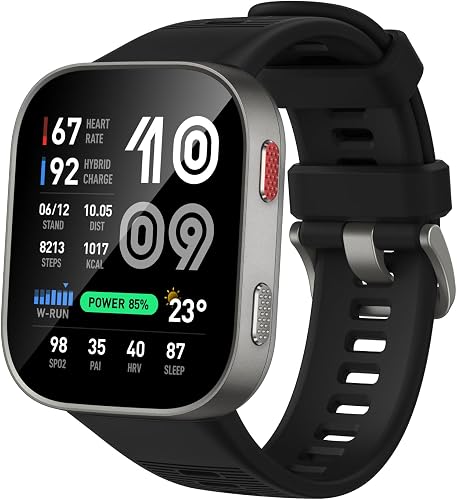
- Up to 20 days of typical use
- 2.07 in AMOLED display
- Built-in GPS
- Offline maps
The Bip Max pairs a 20-day typical-use estimate with a large display, GPS and offline maps. Its screen size is a key comfort consideration.
Pros
- Up to 20 days of typical use
- 2.07 in AMOLED display
- Offline maps and turn-by-turn directions
Cons
- Battery estimate is for typical use
- Large display may feel bulky on smaller wrists
The Amazfit Bip Max offers up to 20 days of typical use and a 2.07 in AMOLED display. Built-in GPS, offline maps and turn-by-turn directions add outdoor support to its everyday features.
Its battery estimate is shorter than Active Max's stated figure but longer than Bip 6's. The large screen is central to the choice, so check whether that size suits your wrist and daily wear preferences.
Choose Bip Max if a large display and a 20-day typical-use estimate are appealing together. For a smaller display and slightly longer stated estimate, compare it with the Active Max.
Which smartwatch battery estimate should you compare?
Compare the estimate for the mode you use most: smartwatch mode for daily wear, GPS mode for recorded activities, or a solar-assisted estimate if your routine meets its outdoor conditions. That makes the numbers more useful than ranking watches by their biggest figure alone.
The Forerunner 165, for example, is rated for up to 11 days in smartwatch mode and up to 19 hours in GPS mode. The Enduro 3's longer figures include solar charging and specific light exposure assumptions.
For always-on screen use, Garmin gives a separate estimate for the vívoactive 5: up to 5 days instead of 11. If the screen stays lit throughout your day, use that figure when comparing.
How to choose a long-lasting smartwatch
Start with your usual charging rhythm and activity length. A watch rated for 11 days may be enough if you charge it during a weekly routine, while someone on long outdoor trips may value solar charging or a multiweek estimate more.
Then compare features that can affect fit for your routine:
- For everyday health and fitness: vívoactive 5 or Venu 4.
- For GPS running: Forerunner 165, with its separate GPS-mode estimate.
- For outdoor solar use: Instinct 3 Solar or Enduro 3, with their stated light exposure assumptions.
- For long typical-use estimates without solar conditions: Active Max, Balance 2 or Bip Max.
- For a large screen: Bip 6 or Bip Max, while considering the case size.
Finally, check the screen mode and watch size. Always-on display can reduce runtime, and a large case can be uncomfortable even when its battery figure looks appealing.
Verdict: which smartwatch battery life fits your day?
Pick the Garmin Enduro 3 if you need the longest stated solar-assisted estimates for long outdoor events and can meet the stated light conditions. Choose the Amazfit Active Max for a long everyday estimate, or the Garmin vívoactive 5 if 11 days and its health and sports features fit your regular routine.
For trail use, compare our hiking smartwatch recommendations. If you want a wider look at features and fit, use the smartwatch buying guide.
Our top 3 picks at a glance
-
1
-
2
-
3
Frequently asked questions
Which smartwatch has the longest battery life?
The Garmin Enduro 3 has the longest stated estimate here: up to 90 days in smartwatch mode with solar charging. That estimate assumes all-day wear and 3 hours outdoors per day in 50,000 lux conditions.
For a model without a solar condition in its estimate, the Amazfit Active Max is stated to last up to 25 days.
How long should a smartwatch battery last?
It depends on the watch and how you use it. The picks here range from up to 11 days to up to 90 days in smartwatch mode, with solar charging affecting the longest estimates.
GPS use and an always-on display can have separate estimates, so compare the mode that matches your routine.
Does GPS drain smartwatch battery faster?
GPS use has its own battery estimate on some watches. For example, the Garmin Forerunner 165 is rated for up to 19 hours in GPS mode and up to 11 days in smartwatch mode.
Check the estimate for the mode you plan to use, especially if you record long activities.
Is solar smartwatch charging worth it?
Solar charging may suit you if you spend regular time outdoors and want to stretch time between charges. The Garmin Instinct 3 Solar estimate assumes 3 hours outdoors daily in 50,000 lux conditions.
If your routine rarely includes that exposure, compare the standard smartwatch-mode estimates too.
Does an always-on display reduce smartwatch battery life?
It can shorten the stated estimate. Garmin gives up to 11 days for the vívoactive 5 in smartwatch mode and up to 5 days with the display always on.
Compare the specific screen mode you plan to use, since battery figures can refer to different settings.


