9 Best Amazfit Watches, From Bip to T-Rex (October 2026)
The best Amazfit watches include the Amazfit T-Rex 3 for rugged outdoor routes, the Amazfit Balance 2 for multisport training, and the Amazfit Active Max for bright-screen training.
On this page (5 sections)
The best Amazfit watch for outdoor routes is the T-Rex 3, while the Bip 6 is a practical everyday pick with built-in GPS and a large display. For longer battery life in a less rugged design, compare the Active Max and Bip Max.
Amazfit's range covers basic daily tracking, guided running and watches with more detailed offline navigation. The right fit depends on how often you use GPS, whether you want maps on your wrist and how much charging you can tolerate.
If you're still deciding what features matter, our smartwatch buying guide explains how to match a watch to your phone and routine. For a brand comparison, see Amazfit vs Garmin.
Our picks at a glance
-
1

-
2

-
3

How we chose the best Amazfit watch
The best Amazfit watch depends on your main use, so we compared the stated battery life, GPS and mapping tools, displays, workout features and phone compatibility. The scores reflect how well each model's listed features match the needs named in its badge.
Our score weighs specs, features and buyer feedback against what you're shopping for.
Battery figures are not always directly comparable because GPS tracking and other settings can affect runtime. Use the typical-use figure as a guide, then check the maker's details for the mode you plan to use most.
Compare the Amazfit watch lineup
The biggest differences are battery life, navigation depth and design focus. Use this table to narrow the options before reading each pick.
| Product | Best for | Display | Battery | Navigation | Our score |
|---|---|---|---|---|---|
| Amazfit T-Rex 3 | rugged outdoor routes | 1.5 in AMOLED | Up to 27 days typical use | Dual-band GPS, maps and turn-by-turn directions | 8.1 |
| Amazfit Balance 2 | multisport training | 1.5 in AMOLED with sapphire glass | Up to 21 days typical use | 8.0 | |
| Amazfit Active Max | bright-screen training | 1.5 in AMOLED, up to 3,000 nits | Up to 25 days | Downloadable maps and turn-by-turn directions | 7.9 |
| Amazfit Bip 6 | everyday value | 1.97 in AMOLED | Up to 14 days | 7.8 | |
| Amazfit T-Rex 3 Pro | advanced trail navigation | 1.32 in AMOLED with sapphire glass | Up to 17 days | Offline maps, rerouting and route creation | 7.7 |
| Amazfit Active 3 | guided running | 1.32 in AMOLED with sapphire glass | Up to 12 days typical use | 7.6 | |
| Amazfit Balance 3 | balanced training and recovery | 1.5 in AMOLED with sapphire glass | Up to 21 days | Dual-band GPS and turn-by-turn directions | 7.5 |
| Amazfit Bip Max | a large display and long battery | 2.07 in AMOLED | Up to 20 days typical use | 7.4 | |
| Amazfit Active 2 Premium | a compact sapphire-screen option | 1.75 in AMOLED with sapphire glass | Up to 10 days typical use | 7.3 |
Which Amazfit watches stand out for different needs?
The T-Rex 3 leads for outdoor use, while the other models suit different mixes of training, screen size, mapping and everyday wear. Start with the feature you will use most often.
Amazfit T-Rex 3: Best for rugged outdoor routes
- 1.5 in AMOLED display
- Dual-band GPS and downloadable maps
- Up to 27 days typical-use battery life
- 170+ workout modes
A rugged pick with dual-band positioning, global maps and a long stated typical-use battery life. It also has a 2,000-nit display and more than 170 workout modes.
Pros
- Dual-band GPS with six satellite systems
- Maps and turn-by-turn navigation
- Up to 27 days typical-use battery life
Cons
- Rugged design may not suit buyers who want a more understated watch
- GPS mode battery life is shorter than typical-use life
The T-Rex 3 is the strongest match for long outdoor days in this group. It combines dual-band positioning across six satellite systems with free global maps and turn-by-turn directions.
Its 1.5 in AMOLED display has a stated peak brightness of 2,000 nits, with Night Mode and Glove Mode. The watch is water-resistant to 328 ft, and its description says it can be used for freediving to 147 ft.
Amazfit states up to 27 days of typical-use battery life and up to 180 hours in GPS mode. Those are different use cases, so frequent GPS tracking can mean charging sooner than the typical-use figure suggests.
Choose it if rugged construction, mapping and long trips matter more than a low-profile look. If you mainly walk, check notifications and track occasional workouts, a less outdoor-focused option may be easier to wear day to day.
Amazfit Balance 2: Best for multisport training
- 1.5 in AMOLED sapphire glass
- Up to 21 days typical-use battery life
- 180+ sports
- Dual-band GPS and downloadable maps
Balance 2 combines multisport tracking, training insights and downloadable maps. Its sapphire glass screen and dual speakers add practical details for training and daily use.
Pros
- Tracks more than 180 sports
- Dual-band GPS with turn-by-turn directions
- Sapphire glass screen
Cons
- Training features may be more than casual users need
- Typical-use battery life is lower than the T-Rex 3
Balance 2 suits people who mix running, strength work, golf and other sports. It supports more than 180 sports, including HYROX modes, and offers downloadable maps with turn-by-turn directions.
The 1.5 in AMOLED screen uses sapphire crystal glass, and the watch has dual speakers for audio cues during training. Its Zepp App features include training calendars, workout history and equipment mileage tracking.
Amazfit states up to 21 days of battery life under typical use. Choose it if you want structured training and recovery features in a design intended to move from workouts into everyday life.
Amazfit Active Max: Best for bright-screen training
- 1.5 in AMOLED display
- 3,000-nit stated peak brightness
- Up to 25 days battery life
- 4GB onboard storage
Active Max pairs a bright AMOLED display with onboard storage for music and downloaded maps. It also offers more than 170 workout modes and Zepp Coach plans.
Pros
- High stated peak display brightness
- 4GB onboard storage
- Downloadable maps for offline use
Cons
- Typical-use battery figure differs between the product details
- Bluetooth message replies require an Android phone
Active Max is a fit for training outdoors in bright conditions. Its 1.5 in AMOLED display is stated to reach 3,000 nits, and the watch has downloadable maps with turn-by-turn directions.
The model includes 4GB of onboard storage for music and maps, plus more than 170 workout modes. Zepp Coach offers personalized plans, while BioCharge is described as a way to track how workouts and stress affect your energy score.
Battery details differ within the information available: one feature description says up to 25 days, while a specification says 24 days. Plan around your use and verify the current details before making battery life the deciding factor.
Amazfit Bip 6: Best for everyday value

- 1.97 in AMOLED display
- Up to 14 days battery life
- 140+ workout modes
- Maps and turn-by-turn directions
Bip 6 offers a large AMOLED screen, built-in GPS and more than 140 workout modes. It is a straightforward everyday option with downloadable maps and a stated battery life of up to 14 days.
Pros
- Large 1.97 in display
- Built-in GPS and downloadable maps
- Compatible with Android and iOS
Cons
- Battery life is shorter than several other picks here
- Does not list dual-band GPS
Bip 6 is an everyday watch with a large 1.97 in AMOLED display and built-in GPS. It supports more than 140 workout modes, personalized coaching, downloadable maps and turn-by-turn directions.
Amazfit states up to 14 days of battery life. Its description lists 50 m water resistance, and the watch is compatible with Android 7.0 and above and iOS 14.0 and above.
Pick it if you want a broad mix of daily tracking and exercise features without prioritizing dual-band GPS or advanced route planning. Our Amazfit Bip 6 review looks more closely at this model.
Amazfit T-Rex 3 Pro: Best for advanced trail navigation

- Sapphire glass and titanium alloy bezel
- Dual-band GPS
- Offline maps with route planning
- Up to 17 days battery life
T-Rex 3 Pro adds route planning, automatic rerouting and a built-in flashlight to a rugged design. It also supports more than 180 sport modes and dual-band GPS.
Pros
- Offline maps and route planning
- Built-in two-color flashlight with SOS signal
- Sapphire glass and titanium alloy bezel
Cons
- Battery life is shorter than the T-Rex 3
- Outdoor features may be unnecessary for routine step tracking
T-Rex 3 Pro is the more navigation-focused rugged option. It offers offline points of interest, route creation, automatic rerouting and detailed ski maps, backed by dual-band GPS across six satellite systems.
Its sapphire glass screen, titanium alloy bezel and buttons, and built-in two-color flashlight set it apart from the T-Rex 3. The watch also supports more than 180 sport modes and has a stated battery life of up to 17 days.
Choose it if you expect to use route planning and low-light features on trails. If long battery life is the main goal, the T-Rex 3 has the higher stated typical-use figure.
Amazfit Active 3: Best for guided running

- 1.32 in AMOLED sapphire glass
- Up to 12 days typical-use battery life
- Offline maps and automatic rerouting
- Built-in running programs
Active 3 centers on running, with training plans from 5K to marathon and offline maps with automatic rerouting. Its stainless steel frame and sapphire glass suit buyers who want a more refined training watch.
Pros
- Built-in running programs from 5K to marathon
- Offline maps with automatic rerouting
- Stainless steel frame and sapphire glass
Cons
- Typical-use battery life is shorter than several picks here
- Some messaging features require Android
Active 3 is designed around running plans and route guidance. It offers built-in programs from 5K to marathon, running metrics and offline maps with turn-by-turn directions and automatic rerouting.
The 1.32 in AMOLED display has sapphire glass, and its stainless steel frame uses four button controls. Amazfit states up to 12 days of typical use, 7 days with heavy use and 24 hours with continuous GPS route tracking.
Choose Active 3 if running support matters more than a larger screen or the longest battery life. Its Zepp App is described as subscription-free.
Amazfit Balance 3: Best for balanced training and recovery

- 1.5 in AMOLED sapphire glass
- Up to 21 days battery life
- Dual-band GPS and offline maps
- Built-in flashlight
Balance 3 combines offline maps and long stated battery life with health, recovery and training features. Its built-in flashlight adds a useful low-light option.
Pros
- Up to 21 days battery life
- Offline maps with automatic rerouting
- White and tactical red flashlight
Cons
- The feature set may be more than a casual wearer needs
- Some detailed workout needs may be better matched by a running-focused model
Balance 3 combines a stated 21-day battery life with dual-band GPS, offline maps, turn-by-turn navigation and automatic rerouting. It also has a 1.5 in AMOLED screen protected by sapphire glass.
The built-in flashlight can use white or tactical red light. Health and recovery features include continuous heart rate, HRV and blood oxygen monitoring, plus sleep, stress and breathing-rate insights.
Pick it if you want broad training and recovery features with mapping. For more focused running plans, Active 3 provides built-in programs from 5K to marathon.
Amazfit Bip Max: Best for a large display and long battery
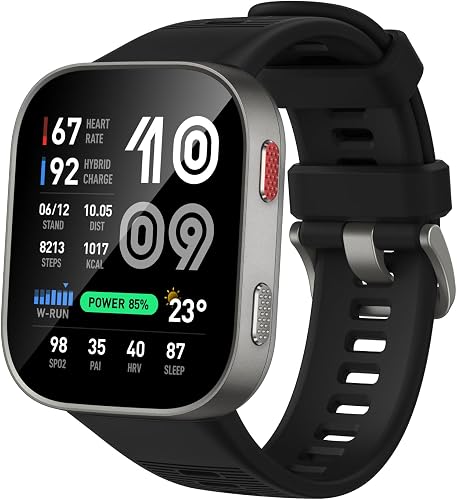
- 2.07 in AMOLED display
- Up to 20 days typical-use battery life
- 4GB onboard storage
- Offline maps
Bip Max emphasizes screen size, storage and battery life for everyday wear and workouts. It has GPS, downloadable maps and more than 150 sports modes.
Pros
- Largest stated display in this group
- Up to 20 days typical-use battery life
- 4GB onboard storage
Cons
- Large screen may not suit every wrist
- GPS uses five satellite systems rather than dual-band positioning
Bip Max prioritizes a large screen and less frequent charging. Its 2.07 in AMOLED display is the largest stated display among these picks, and Amazfit states up to 20 days of typical-use battery life.
It has 4GB of onboard storage, GPS, downloadable maps, turn-by-turn directions and off-track alerts. The watch supports more than 150 sports modes, with Zepp Coach routines and equipment mileage tracking in the app.
Choose Bip Max if screen space and battery life matter more than a compact case. Its GPS support uses five satellite systems, while the T-Rex and Balance models here describe dual-band GPS across six.
Amazfit Active 2 Premium: Best for a compact sapphire-screen option

- 1.75 in AMOLED sapphire glass
- Up to 10 days typical-use battery life
- 160+ workout modes
- Downloadable maps
Active 2 Premium pairs a stainless steel body and sapphire glass with running plans, downloadable maps and more than 160 workout modes. Its stated typical-use battery life is shorter than the other picks here.
Pros
- Sapphire glass and stainless steel body
- Downloadable maps with voice directions
- Training plans for general workouts and running
Cons
- Shortest stated typical-use battery life in this group
- Water resistance details are not specified here
Active 2 Premium offers a polished stainless steel body with a 1.75 in AMOLED sapphire glass screen. It supports more than 160 workout modes, downloadable maps and Zepp Coach plans for general workouts and running events from 3K to marathon.
Amazfit states up to 10 days of typical-use battery life, up to 5 days with heavy use and up to 21 hours of continuous GPS tracking. The shorter runtime makes it a better fit when its materials and training features matter more than avoiding regular charging.
Choose it for a durable screen and varied training tools in a smaller display than Bip Max. Check that its stated compatibility matches your phone before buying.
What should you compare before choosing an Amazfit watch?
Compare GPS use, battery expectations and the watch's main job before focusing on extra workout modes. Those choices have the clearest effect on whether a model fits your routine.
Is GPS and offline mapping a priority?
Choose a watch with mapping and route guidance if you want directions on your wrist or expect to walk where phone service is limited. The T-Rex 3, T-Rex 3 Pro, Balance 2, Balance 3, Active Max and Active 3 all describe downloadable or offline maps.
For occasional GPS walks, you may not need advanced route planning. If hiking is a regular part of your routine, compare these features with our guide to the best smartwatches for hiking.
How much battery life do you need?
The longest stated typical-use figures here are up to 27 days for T-Rex 3, 25 days for Active Max and 21 days for Balance 2 and Balance 3. Bip 6 is stated at up to 14 days, while Active 2 Premium is stated at up to 10 days.
GPS use can shorten battery life, and some models provide separate continuous GPS figures. Compare the mode that resembles your use most closely, and see our guide to smartwatches with long battery life for more options.
Do you want a rugged watch or an everyday design?
T-Rex 3 and T-Rex 3 Pro emphasize rugged materials, outdoor navigation and water activities. Bip 6 and Bip Max lean toward everyday wear, with large displays and activity features.
Balance 2 and Balance 3 sit between those needs, pairing training and recovery tools with a design described for daily life. You can also compare the brand's approach with our Amazfit and Garmin comparison.
Which Amazfit watch should you choose?
Choose the T-Rex 3 for rugged routes and long battery life, Balance 2 for varied multisport training, or Bip 6 for an everyday watch with GPS and a large screen. Active Max and Bip Max make sense when battery and display size lead your priorities.
For advanced trail planning, consider T-Rex 3 Pro. For running plans, compare Active 3 and Active 2 Premium, then match their battery figures and screen sizes to your routine.
If you're still sorting out which features you need, start with our smartwatch buying guide before narrowing the Amazfit lineup.
Our top 3 picks at a glance
-
1
-
2
-
3
Frequently asked questions
Which Amazfit watch has the longest battery life?
The T-Rex 3 has the longest stated typical-use battery life in this group, at up to 27 days. Active Max is stated at up to 25 days, and Bip Max at up to 20 days.
Actual time between charges can change with settings and GPS use, so treat these figures as a starting point.
Which Amazfit watch is best for hiking?
The T-Rex 3 is a strong fit for hiking because it has dual-band GPS, downloadable maps, turn-by-turn directions and a stated typical-use battery life of up to 27 days. T-Rex 3 Pro adds route planning, automatic rerouting and a flashlight.
For a broader comparison, see our hiking smartwatch picks.
Can Amazfit watches work with iPhone?
The Amazfit models in this guide are described as compatible with iOS devices, though supported iOS versions vary by model. Check your phone's software version against the requirements for the watch you choose.
For other phone and watch pairing questions, start with our smartwatch buying guide.
Do Amazfit watches need a subscription?
The Active 3 and Balance 3 descriptions say the Zepp App is available without a subscription. The other models also connect with Zepp features, but subscription details aren't specified here.
Check the app requirements for the features you plan to use before choosing a watch.