10 Best Smartwatches With Built-In GPS for Walks and Runs (October 2026)
The best smartwatches with built-in GPS for walks and runs include the Garmin Forerunner 165 for regular runs, the Apple Watch SE 3 GPS 44mm for iPhone everyday use, and the Apple Watch Series 12 GPS 42mm for more fitness metrics.
On this page (4 sections)
The best smartwatch with GPS for most walks and runs is the Garmin Forerunner 165. It has built-in GPS for pace and distance, up to 19 hours in GPS mode, and Garmin Coach plans for running goals.
For a phone-first watch, consider an Apple Watch if you use an iPhone. For longer outings or offline directions, compare the Amazfit Active 3 and Bip Max, which include map features and longer stated battery life.
A GPS label does not guarantee that every model has standalone route tracking. The Pixel Watch 5 facts here say “No GPS,” so it does not fit a shortlist where built-in GPS is essential.
Our picks at a glance
-
1

-
2

-
3

How we chose smartwatches with built-in GPS
We compared GPS availability, stated GPS or typical battery life, running and walking features, phone compatibility, and navigation tools. Our score weighs specs, features and buyer feedback against what you're shopping for.
Built-in GPS matters if you want your watch to record route and distance without using your phone's location. For a broader way to compare watches by fit and daily features, see our smartwatch buying guide.
| Product | Best for | GPS battery | Smartwatch battery | Display | Our score |
|---|---|---|---|---|---|
| Garmin Forerunner 165 | regular runs | Up to 19 hours | Up to 11 days | AMOLED touchscreen and buttons | 8.9 |
| Apple Watch SE 3 GPS 44mm | iPhone everyday use | 8.7 | |||
| Apple Watch Series 12 GPS 42mm | more fitness metrics | 8.5 | |||
| Garmin Forerunner 265 46mm | training detail | Up to 20 hours | Up to 13 days | AMOLED touchscreen and buttons | 8.2 |
| Garmin Forerunner 570 42mm | a smaller running watch | Up to 18 hours | Up to 10 days | AMOLED touchscreen and buttons | 8.1 |
| Google Pixel Watch 5 41mm | Android health tracking | 8.1 | |||
| Samsung Galaxy Watch 8 Classic 46mm | Samsung phone features | 8.0 | |||
| Amazfit Active 3 | offline maps | Up to 24 hours of continuous route tracking | 7.6 | ||
| Amazfit Bip Max | longer battery life | 7.4 | |||
| Garmin Forerunner 55 | simple run tracking | 7.4 |
The best GPS smartwatches for walks and runs
The Forerunner 165 is the strongest general running pick, while the other models suit different phones, training needs, and battery priorities. The products below are ordered by score.
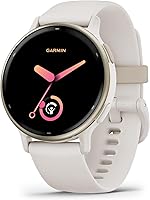
Garmin Forerunner 165: Best for regular runs
- Built-in GPS
- Up to 19 hours in GPS mode
- Pace and distance tracking
- Up to 11 days in smartwatch mode
A running-focused choice with built-in GPS, pace and distance tracking, adaptive workout suggestions, and recovery features.
Pros
- Built-in GPS for pace and distance
- Garmin Coach and race adaptive plans
- 25+ activity profiles
Cons
- GPS battery time is shorter than smartwatch mode
- Some safety features need a paired phone and network coverage
The Forerunner 165 is the clearest fit for runners who want dedicated training tools without moving to a more feature-heavy model. Its built-in GPS tracks pace and distance, and the AMOLED touchscreen works alongside traditional buttons.
Garmin includes more than 25 activity profiles, including running, cycling, HIIT, and strength. Daily suggested workouts adapt based on performance and recovery, while Garmin Coach and race adaptive plans can help you prepare for an event.
Battery claims vary by mode: Garmin states up to 11 days in smartwatch mode and up to 19 hours in GPS mode. That distinction is useful when you plan longer outings or leave GPS recording on for extended periods.
The watch also offers a morning report with sleep, recovery, training outlook, weather, and HRV status. Garmin describes these metrics as close estimates, so treat them as tracking information rather than medical measures.
Choose it for regular walks and runs with pace and distance tracking. Its safety features need setup, a paired compatible smartphone, and network coverage to send a live location.
Apple Watch SE 3 GPS 44mm: Best for iPhone everyday use
- GPS model
- Running and strength workouts
- Up to 18 hours of battery life
- Works with iPhone or Wi-Fi
An everyday iPhone watch that tracks running workouts and offers real-time metrics alongside calls, texts, and notifications.
Pros
- Tracks running workouts
- Connects with an iPhone or Wi-Fi
- Fast charging is included
Cons
- Battery life is stated as 18 hours
- Requires an iPhone for the listed phone connection
The Apple Watch SE 3 GPS 44mm fits iPhone owners who want workouts and everyday connection on one watch. It can track running and strength workouts, show real-time metrics, and connect through an iPhone or Wi-Fi.
Apple states all-day battery life of up to 18 hours, with fast charging that can provide up to 8 hours of battery in 15 minutes. That gives you useful charging flexibility, but the stated runtime is lower than the GPS-mode figures for several Garmin and Amazfit picks.
The SE 3 also includes sleep tracking, temperature sensing for health insights, and hard-fall or severe-car-crash detection. These features add context beyond a walk or run, though some health features require supported apps and setup.
If you are deciding between this and a more advanced Apple model, our Apple Watch vs Galaxy Watch comparison explains how phone choice shapes the decision. For the SE 3, the main fit is an iPhone user who values workout tracking and everyday smartwatch tools.
Apple Watch Series 12 GPS 42mm: Best for more fitness metrics
- GPS model
- Pacer and heart rate zones
- Up to 24 hours of normal use
- Works with iPhone or Wi-Fi
An iPhone-connected option with running tools such as Pacer and heart rate zones, plus broader health and sleep features.
Pros
- Pacer and heart rate zones for workouts
- Up to 24 hours of normal use
- Fast charging is included
Cons
- The listed GPS model works with iPhone or Wi-Fi
- Advanced features depend on compatible devices or services
The Series 12 GPS 42mm suits iPhone owners who want more workout and health features. Apple lists Pacer and Heart Rate Zones for workouts, plus running and hiking among its supported activities.
Its battery is rated for up to 24 hours of normal use, and a 15-minute fast charge is stated to provide up to 12 hours of normal use. These are normal-use figures, so don't read them as a GPS workout runtime.
The Series 12 also tracks sleep and overnight health metrics and includes fall and car-crash detection. Apple says its GPS model works with an iPhone or Wi-Fi, which makes phone compatibility a key part of the choice.
Pick it over the SE 3 when its additional workout and health tools matter to you. If your priority is a simpler iPhone GPS watch, the SE 3 covers running workouts and daily connection with a shorter feature list.
Garmin Forerunner 265 46mm: Best for training detail

- Multi-band GPS with SatIQ
- Up to 20 hours in GPS mode
- Training readiness and race planning
- 30+ activity profiles
A training-focused running watch with multi-band GPS, race planning, training readiness, and a broad set of activity profiles.
Pros
- Multi-band GPS with SatIQ
- Adapting suggested workouts and race planning
- 30+ activity profiles
Cons
- Training readiness metrics are estimates
- The 46 mm size may not suit every wrist
The Forerunner 265 is a stronger match for runners who want detailed training guidance and multi-band GPS. Garmin says its SatIQ and multi-band GNSS support positioning accuracy in challenging environments while optimizing battery use.
It offers up to 20 hours in GPS mode and up to 13 days in smartwatch mode. The watch also includes a training readiness score based on sleep quality, recovery, training load, and HRV status, plus race planning that adapts suggested workouts to performance and recovery.
More than 30 activity profiles cover running, triathlons, cycling, and open-water swimming. That range makes it a sensible choice if running is central but not your only activity.
The 46 mm size and training features are more than some casual walkers need. For simpler run and walk tracking, the Forerunner 165 has fewer listed activity profiles but still includes GPS, pace, distance, and adaptive suggestions.
Garmin Forerunner 570 42mm: Best for a smaller running watch

- Built-in GPS
- Up to 18 hours in GPS mode
- 42 mm size
- Up to 10 days in smartwatch mode
A 42 mm running watch with built-in GPS, adaptive plans, training readiness, and a microphone and speaker for paired-phone calls.
Pros
- 42 mm size
- Garmin Coach plans for running and triathlons
- Built-in GPS
Cons
- GPS mode battery is up to 18 hours
- Calls require a paired smartphone
The Forerunner 570 42mm offers built-in GPS and a smaller case size, with training tools aimed at runners and triathletes. Garmin states up to 18 hours of GPS battery and up to 10 days in smartwatch mode.
Its training features include Garmin Coach plans, adaptive daily workout suggestions, and a training readiness score. The watch also has more than 30 activity profiles, including track running, triathlon, cycling, and open-water swimming.
A microphone and speaker allow calls from the wrist when the watch is paired with a smartphone. That connection is also needed for safety and tracking features, which require setup and network coverage.
Choose the 570 if you want a 42 mm running watch with GPS and coaching features. If you want a longer stated GPS runtime or multi-band GPS, compare it with the Forerunner 265.
Google Pixel Watch 5 41mm: Best for Android health tracking

- Android only
- Up to 40 hours of battery life
- Health and sleep tracking
- Product data says no GPS
This Android smartwatch offers health and sleep features, but the available GPS information says it has no GPS. It is not a match if you need built-in route tracking.
Pros
- Up to 40 hours of battery life
- Android health and sleep features
- 41 mm size
Cons
- GPS information says no GPS
- Not compatible with iPhone
The Pixel Watch 5 is an Android health and sleep watch, but the GPS information provided says it has no GPS. That makes it a poor fit when standalone route tracking is a must.
It is compatible with Android devices only and offers up to 40 hours of battery life. Its listed features include sleep insights, heart rate tracking, and loss-of-pulse detection, so it may suit someone who prioritizes those functions over GPS workouts.
If you use a Samsung phone, the Galaxy Watch 8 Classic below has built-in GPS and Running Coach. Android phone owners can also compare more models in our Android smartwatch guide.
Check the exact GPS capability before choosing any watch for phone-free walks or runs. In this group, the Pixel Watch 5's stated “No GPS” is a clear reason to pick a different model for that purpose.
Samsung Galaxy Watch 8 Classic 46mm: Best for Samsung phone features

- Built-in GPS
- Running Coach
- Works with Android phones
- Up to 30 hours of battery life
A larger Android watch with built-in GPS, Running Coach, and a rotating bezel, aimed at buyers who also want wellness and sleep features.
Pros
- Built-in GPS
- Running Coach
- Rotating bezel
Cons
- 46 mm case size
- Some features require a compatible Samsung phone and apps
The Galaxy Watch 8 Classic 46mm includes built-in GPS and Running Coach for outdoor runs. Samsung says the coach analyzes factors such as age, weight, oxygen levels, and heart rate to guide a run.
The watch pairs with Android smartphones, including Samsung phones and other Android devices. Some features require a compatible Galaxy phone, Samsung Health, or a Samsung account, so check those requirements if you want its health and wellness tools.
Its rotating bezel and 46 mm case set it apart from smaller running watches. Samsung lists 30 hours of battery life, so compare your charging routine with the longer smartwatch-mode claims of some Garmin and Amazfit picks.
Choose it if you want built-in GPS with Android features and a classic watch design. If training metrics and longer GPS-mode runtime matter more than daily smartwatch functions, the Forerunner 265 is a closer fit.
Amazfit Active 3: Best for offline maps

- Six GPS satellite systems
- Up to 24 hours of continuous GPS
- Offline maps and turn-by-turn directions
- Up to 12 days of typical battery
A GPS-focused Amazfit with offline maps, route directions, and training plans, plus a stated 24 hours of continuous GPS route tracking.
Pros
- Offline maps and rerouting
- Six GPS satellite systems
- Over 170 workout modes
Cons
- Turn-by-turn directions require downloaded maps
- Some messaging features are Android-compatible
The Amazfit Active 3 stands out for route tools and GPS endurance. It uses six GPS satellite systems and supports offline maps, turn-by-turn directions, and automatic rerouting without a phone.
Amazfit states up to 24 hours of continuous GPS route tracking and up to 12 days of typical use. The watch also includes over 170 workout modes and training programs from 5K to marathon through Zepp Coach.
Its four button controls sit alongside an AMOLED touchscreen, and the watch can make Bluetooth calls when connected to a phone. The Zepp app is described as free and subscription-free for the listed tracking and trend features.
Pick it if offline maps and longer GPS sessions are central to your walks or runs. Download maps in advance if you want to use them offline, and note that some messaging features are Android-compatible.
Amazfit Bip Max: Best for longer battery life
- Built-in GPS with five satellite systems
- Up to 20 days of typical battery
- Offline maps and off-track alerts
- 150+ sports modes
A large-screen everyday watch with built-in GPS, offline maps, and a long stated typical-use battery life.
Pros
- Up to 20 days of typical-use battery
- Offline maps and off-track alerts
- 150+ sports modes
Cons
- Large 2.07 in display
- Battery life varies with use
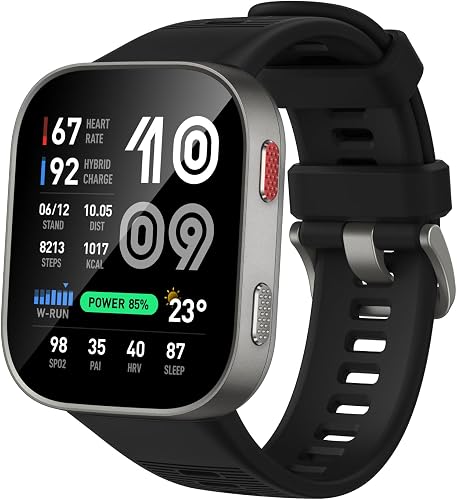
The Amazfit Bip Max pairs built-in GPS with a large screen and up to 20 days of typical-use battery life. Its GPS uses five satellite systems, and its map tools include turn-by-turn directions and off-track alerts.
It supports offline maps downloaded through the Zepp app, plus more than 150 sports modes. A 4 GB onboard storage capacity is also listed, though the specific map and media use may depend on setup.
The 2.07 in AMOLED screen is the largest stated display among these picks. That can make information easier to see at a glance, but the larger screen may not suit someone who prefers a compact watch.
Choose the Bip Max if you want a longer stated typical-use battery and map support for everyday walks and runs. The Active 3 offers a more explicit continuous GPS runtime figure and six satellite systems.
Garmin Forerunner 55: Best for simple run tracking

- Built-in GPS
- Pace, distance, speed, and time tracking
- 17 activity profiles
- Training suggestions and plans
A straightforward running watch for tracking pace, distance, speed, and time, with suggested workouts and free training plans.
Pros
- Simple start for a run or walk
- Multi-satellite support
- Plans for 5K, 10K, and half-marathon goals
Cons
- The listed display is 1.04 in
- Exact battery life is not specified in the product facts here
The Forerunner 55 is a straightforward Garmin option for people who mainly want run and walk tracking. It records time, distance, speed, pace, and heart rate from the wrist, and supports multiple satellite systems.
Its 17 activity profiles include running, cycling, pool swimming, virtual running, Pilates, HIIT, and breathing exercises. Daily training suggestions and free plans for 5K, 10K, and half-marathon goals add structure without requiring a more advanced training watch.
The product facts here do not give a precise battery runtime figure. Garmin describes it as having long battery life, so compare that with the specific GPS-mode hours stated for the Forerunner 165, 265, and 570 if runtime is a deciding factor.
Choose the Forerunner 55 for a simple run-first feature set. If you want an AMOLED display, more activity profiles, or a stated GPS-mode runtime, the Forerunner 165 is the more detailed step up.
What should you check before buying a GPS smartwatch?
Start with phone compatibility, GPS runtime, and the features you will use during a walk or run. These details often matter more than a long list of extra health tools.
Confirm that GPS is built into the watch. A watch can have mapping or phone connectivity without having its own GPS, as the Pixel Watch 5 facts here show.
Compare the right battery figure. GPS-mode or continuous GPS runtime is the useful number for a long recorded outing.
Smartwatch-mode and typical-use estimates describe different use.
Match the watch to your phone. The Apple Watch GPS models here are designed to work with iPhone or Wi-Fi, while the Pixel Watch 5 works with Android only.
The Galaxy Watch 8 Classic also pairs with Android phones.
Decide whether you need training or navigation tools. Garmin's Forerunner watches add training plans and recovery or readiness information, while the Amazfit Active 3 and Bip Max offer offline map features.
For longer trail days where route and battery needs can change, see our guide to smartwatches for hiking. If charging less often matters most, compare the long-battery smartwatch picks.
Which smartwatch with GPS should you choose?
Choose the Forerunner 165 for a balanced running watch with built-in GPS, pace and distance tracking, adaptive suggestions, and up to 19 hours in GPS mode. Pick the Forerunner 265 if multi-band GPS and deeper training tools matter more.
Choose the Apple Watch SE 3 or Series 12 if you use an iPhone and want workout tracking alongside everyday smartwatch features. For offline maps, compare the Amazfit Active 3 and Bip Max, and verify GPS capability before buying any model.
See our daily wear smartwatch picks for more everyday options, or use the smartwatch buying guide to compare fit, phone compatibility, and features.
Our top 3 picks at a glance
-
1
-
2
-
3
Frequently asked questions
What does built-in GPS do on a smartwatch?
Built-in GPS lets a watch track your route and distance without relying on your phone's GPS. Many watches also use it for pace during a run or walk.
Check whether a model has its own GPS before buying.
Phone compatibility or a GPS label alone does not tell you how route tracking works.
Do you need your phone to use a GPS watch?
A watch with built-in GPS can record location without your phone during an activity. Phone pairing may still be needed for notifications, calls, safety messages, setup, or syncing workouts.
For example, Garmin's safety and tracking features require a paired compatible smartphone and network coverage.
How much GPS battery life do you need?
Choose enough GPS time to cover your longest planned outing, with room for setup and delays. The Forerunner 165 is rated for up to 19 hours in GPS mode, while the Amazfit Active 3 is rated for up to 24 hours of continuous GPS route tracking.
GPS use can differ from smartwatch-mode battery estimates.
Can a smartwatch track walks as well as runs?
Yes. Several watches here include walking or broad activity tracking alongside running features.
The Forerunner 165 has 25+ activity profiles, and the Forerunner 55 includes walking and running among its listed profiles.
Choose a model whose activity options and controls suit the way you plan to use it.