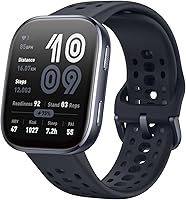
Amazfit Active 3 Premium vs Active Max: Which Is Better? (November 2026)
Pick the Active Max if you want the bigger screen, longer battery and offline maps; pick the Active 3 Premium if a lighter watch on your wrist matters more. In this Amazfit Active 3 Premium vs Active Max comparison, screen size and battery life decide it for most people.
On this page (7 sections)
Pick the Active Max if you want the bigger screen, longer battery and offline maps; pick the Active 3 Premium if a lighter watch on your wrist matters more. In this amazfit active 3 premium vs active max comparison, the screen size and battery gap do most of the deciding for daily wear.
The Active Max puts a 1.5-inch AMOLED display and up to 25 days of battery on your wrist. It also carries 4GB of storage for music and downloaded maps.
The Active 3 Premium is the slimmer option in the pair, and its smaller case sits closer to the wrist.
Both watches aim at the same buyer: someone who wants a good-looking daily watch with fitness tracking and long battery life. The split comes down to how much screen you want and how much bulk you'll accept.

 Best for protecting the Active 3 Premium
Tiorecime 6 Pack Case for Active 3 Premium
Amazfit Active 3 Premium vs Active Max: the quick verdict
The Active Max is the better buy for most readers because its larger screen and longer battery are the two things daily wear asks for most. The Active 3 Premium makes more sense when a smaller case and a lighter feel matter more than display size.
The Active Max's 1.5-inch AMOLED screen reaches 3,000 nits, so it stays readable in bright sun. That's the kind of detail you notice every time you check a notification outdoors.
A screen this bright also means you rarely have to squint or shade the watch with your free hand on a sunny walk.
Battery life is the other clear split. Amazfit says the Active Max runs up to 25 days, and the spec sheet puts average battery life at 24 days.
That's a long stretch between charges for a watch with GPS and a bright screen. Compare that with the nightly charging most smartwatches demand and the difference shows up in your routine, not just on a spec sheet.
The Active 3 Premium wins on wrist presence. A smaller case is less likely to catch on a jacket cuff or feel heavy during a long day at a desk.
If you've worn a big watch before and disliked it, that matters.
Neither watch is a specialist tool. Both are daily-wear picks for step counts, workouts and notifications.
Our Amazfit vs Garmin comparison is the better read if you're still deciding on the brand itself.
The two watches side by side
The table below lines up the specs that change the daily experience. Screen, battery, storage and weight are the fields worth reading closely.
| Product | Best for | Display | Battery | Storage | Our score |
|---|---|---|---|---|---|
| Amazfit Active Max | bigger screens and longer battery | 1.5 in AMOLED | Up to 25 days | 4GB | 7.9 |
| Tiorecime 6 Pack Case for Active 3 Premium | protecting the Active 3 Premium | 9.7 | |||
| Amazfit Official Charging Base | keeping either watch topped up | 9.4 |
The Active Max's 1.5-inch AMOLED display is the headline difference. Its 3,000-nit rating is a maker figure for peak brightness, and it means the screen holds up when you're outside.
The glossy screen surface keeps colors rich, though it can pick up fingerprints in the same way a phone screen does.
Storage is 4GB on the Active Max. That space takes music and downloaded terrain or ski maps, which you can use offline when there's no signal.
It also carries five satellite systems for position tracking, which helps when you move between open sky and tree cover.
The Active Max weighs 1.97 ounces in its listed dimensions. That's light for a watch with a 1.5-inch screen, but the case is still bigger than the Active 3 Premium's.
Its listed dimensions are 6.81 by 3.54 by 1.34 inches for the package, so plan for a wide wrist presence.
The charging base in the box is a magnetic dock. Note that the Active Max's included charger is a magnetic charging base without a USB Type-C cable, so plan for that when you travel.
A spare official base solves the problem neatly. The dock itself measures 6.93 by 3.7 by 0.95 inches and weighs 1.13 ounces, so it packs flat in a bag.
What the table leaves out
The specs don't list water resistance, strap width or screen resolution for either model. Read those on the listing page if they matter to you.
The comparison here sticks to what the product data states.
Which screen size suits your wrist and your week?
Choose the Active Max's 1.5-inch screen if you read notifications and workout stats at arm's length; choose the Active 3 Premium's smaller display if you want the watch to disappear under a cuff. Screen size is the first thing you'll notice every day.
A bigger AMOLED panel fits more text per glance. You can read a message preview or a running split without lifting your wrist closer to your face.
That's a real comfort on a run or while carrying shopping. The touchscreen and side buttons both work for navigation, so you can tap or press depending on the task.
Brightness matters as much as size. The Active Max's 3,000-nit peak brightness is built for sunlight, so the display stays legible at midday.
A dimmer screen forces you to shade it with your hand. The AMOLED panel also keeps colors strong rather than washed out in direct light.
The trade-off is bulk. A 1.5-inch case sits wide on a small wrist and can crowd the space between your wrist bone and your hand.
Try on a large watch before you commit if you've never worn one. A wide case also makes a silicone band sit differently on the wrist.
The Active 3 Premium's smaller display keeps the watch closer to a classic watch profile. It's the safer pick for a narrow wrist, a formal sleeve or anyone who takes the watch off to type.
A slim case slips under a shirt cuff without a fight.
Screen size and battery are linked
A larger, brighter screen draws more power. The Active Max offsets that with its battery rating, so the size gain doesn't cost you charging frequency.
That's the balance that makes the bigger model work as a daily watch. The two features are sold together, not as a trade-off you have to accept.
Which battery life fits your charging habits?
The Active Max's up to 25 days of battery is the practical winner for anyone who dislikes a nightly charging routine. The Active 3 Premium's smaller body has less room for a battery, and that shapes how often you'll reach for the charger.
Amazfit states up to 25 days for the Active Max, with a 24-day average battery life figure. That's weeks, not days, between charges.
For most people that means charging roughly once or twice a month. The battery is a 200 mAh lithium polymer cell, so the rating depends on how hard you push it.
Long battery changes how you use a watch. You stop thinking about the charger and start wearing it to sleep for sleep tracking.
A watch that needs charging every night often ends up on the nightstand instead. The Active Max's rating makes overnight wear realistic without a midday top-up.
GPS sessions, music playback and a bright always-on setting all pull the battery down faster. A long hike with tracking on will use more than a desk day.
Bluetooth calls through the speaker and mic also add drain when you use them often.
If you already own an Amazfit, a spare dock helps here. The official Amazfit charging base question comes up often in our Bip 6 review, and the same logic applies: one charger at home, one at work.
The magnetic base seats the watch without lining up pins.
When charging speed matters more than endurance
If you only wear a watch during workouts, a smaller battery that charges quickly can be fine. For all-day wear, the longer rating is the one that keeps the watch on your wrist.
Consider how often you'd actually remember to charge before you let endurance decide it.
Which one fits an iPhone or Android phone?
Both watches pair with iOS and Android over Bluetooth, so the phone choice doesn't decide this comparison. Some features still behave differently depending on which phone you carry.
The Active Max supports Bluetooth calls through its built-in speaker and mic. You can take a call from the trail without pulling out your phone.
Zepp Flow handles hands-free message replies, but that specific feature needs an Android phone. The listing states the Android requirement plainly, so treat it as a real limit if you carry an iPhone.
On an iPhone, you still get notifications, health tracking and workout sync. Message replies are the part that changes.
If replying from your wrist is a must, check that your phone supports it before buying. Voice control through Zepp Flow falls into the same category.
Our guide to the best smartwatch for iPhone besides Apple Watch covers how other brands handle iPhone pairing. The short version: expect notifications and fitness sync to work well, and expect some reply features to be Android-only.
That pattern holds across most watches that aren't Apple's own.
The Active 3 Premium follows the same pattern. The phone platform isn't the deciding factor between these two models, but the feature list is worth checking against your phone.
The language setting on the Active Max is English, so check the listing if you need another language.
Calls, music and maps on the wrist
The Active Max's 4GB storage means you can carry music and maps without your phone. That's a bigger deal than phone pairing for runners and hikers who leave the phone at home.
Music playback also needs the battery to last, which is where the long rating earns its keep.
Which training features do you actually need?
The Active Max brings 170+ workout modes and Zepp Coach plans, so it suits anyone who follows a structured training week. If you only count steps and track a daily walk, the extra modes won't change much.
The Active Max's training package includes 170+ workout modes and personalized Zepp Coach running plans. Those plans cover 3K, 5K, 10K, half marathon and full marathon distances.
The coach adapts to your performance and recovery. The watch also handles strength sessions and long runs in the same mode list.
BioCharge energy monitoring is the other training feature. It gives a daily score that shifts with workouts and stress, so you can see when to push and when to rest.
That's a recovery signal rather than a training plan. It pairs with the coach, so the two features read best together.
Offline maps are the standout for outdoor use. You can download terrain and ski maps to the watch and follow turn-by-turn directions without a signal.
Built-in positioning with five satellite systems keeps the track accurate. That combination is what makes the Active Max useful on a trail where your phone has no bars.
For a daily-wear buyer who mostly walks and does the odd gym session, most of this is headroom. The step counter and heart rate tracking do the everyday job on either watch.
The extra modes matter when you train with a plan. Activity tracking and multisport tracking are listed as additional features, so the basics are covered either way.
If training structure is your main reason for buying, the Active Max's coach and maps make it the stronger pick. Our Bip 6 review looks at how Amazfit handles the basics if you want a cheaper entry point.
Recovery scores and daily wear
BioCharge isn't a medical measurement. Treat the score as a nudge about training load, not a health diagnosis.
It's most useful when you check it alongside how you actually feel. A high score after a hard week is a reason to look at your sleep as well as your training.
Which one should you buy?
Buy the Active Max for most people: the 1.5-inch screen, up to 25 days of battery and offline maps make it the better daily watch. Buy the Active 3 Premium when a smaller, lighter case matters more than display size and endurance.
The Active Max is the clear overall winner in this amazfit active 3 premium vs active max matchup. Its bigger screen is easier to read, its battery lasts weeks, and its storage and maps add real function for runners and hikers.
The 1.97-ounce weight is light enough for a large watch. The 4.5-star review average from over a thousand ratings suggests buyers find the formula works.
The Active 3 Premium earns its place on fit. A smaller case suits narrow wrists, formal sleeves and anyone who finds big watches annoying.
If you've tried a large watch and sent it back, the smaller model is the right call. It's also the model the six-pack case is built for, which makes protection simple.
Either way, protection and charging are worth planning. The Tiorecime six-pack keeps an Active 3 Premium covered in six colors, and it only fits that model.
The pack includes Black, Dark Blue, Dark Green, Clear, Pink and White, so you can swap the look to match an outfit. Each case uses hard polycarbonate with a tempered glass screen cover rated 9H.
The snap-on fit leaves the buttons and charging port open, so you don't remove the case to charge. It's a light, glossy layer that adds shock and scratch protection without much bulk.
For the Active Max, a spare official charging base means one dock at home and one at work. It's made by Amazfit and fits the Active Max plus the T-Rex 3, T-Rex 3 Pro, Balance 2 and Helio Strap.
Check the Bip 6 vs Band 7 comparison if you're weighing a cheaper Amazfit against a fitness band instead.
Frequently asked questions
Is the Active Max bigger than the Active 3 Premium?
Yes. The Active Max uses a 1.5-inch AMOLED display, while the Active 3 Premium is the smaller model in the pair.
The larger screen is easier to read at a glance, but the bigger case takes up more wrist space.
Does the Active Max work with an iPhone?
Yes. The Active Max connects over Bluetooth to both iOS and Android devices.
Some features differ by phone, so message replies through Zepp Flow need an Android phone.
How long does the Active Max battery last?
Amazfit says the Active Max runs up to 25 days per charge. The battery average life figure is 24 days.
Heavy GPS use and always-on display settings will shorten that, as with any watch.
Will the Active 3 Premium case fit the Active Max?
No. The Tiorecime six-pack is made only for the Active 3 Premium and does not fit the Active Max, the original Active or the Active 2.
Buy a case listed for the exact model you own.
Do I need the official charging base?
No. The Active Max ships with a magnetic charging base.
A spare official dock helps if you want one charger at home and one at work, and it also fits several other Amazfit models.